

Water’s AMP8 Challenge: Too Much Work, Not Enough Hands
Water and wastewater services in England and Wales are delivered by licensed private companies under Ofwat's economic regulation, with investment and performance managed through five-year Asset Management Periods (AMPs). AMP8, running from April 2025 to March 2030, is the largest of these cycles to date, with water companies proposing between £96 billion and £104 billion of investment, an increase of roughly 88% on AMP7. The programme spans everything from reducing storm overflow spills and cutting leakage to reservoir construction, digitalisation and nature-based solutions.
Against this backdrop, water has become an increasingly significant part of the UK infrastructure investment landscape, sitting alongside comparable step-changes in energy, rail and defence. However, the scale of work planned for AMP8 is now significantly outstripping the current availability of skilled project, commercial and engineering talent. This raises a fundamental delivery question for the sector: not whether the funding exists, but whether the people do.
AMP8's Skills Gap: By the Numbers
The scale of this challenge is best understood through the data itself, with independent research from across the sector consistently pointing to the same conclusion: demand for skilled talent is rising faster than the workforce can supply it.
43,700 new recruits needed by 2030, which is a 36% increase [1]
30,000+ new highly-skilled jobs are expected to be created across the AMP8 period [2][3]
69% of water professionals believe that the industry lacks capacity to deliver its committed work [1]
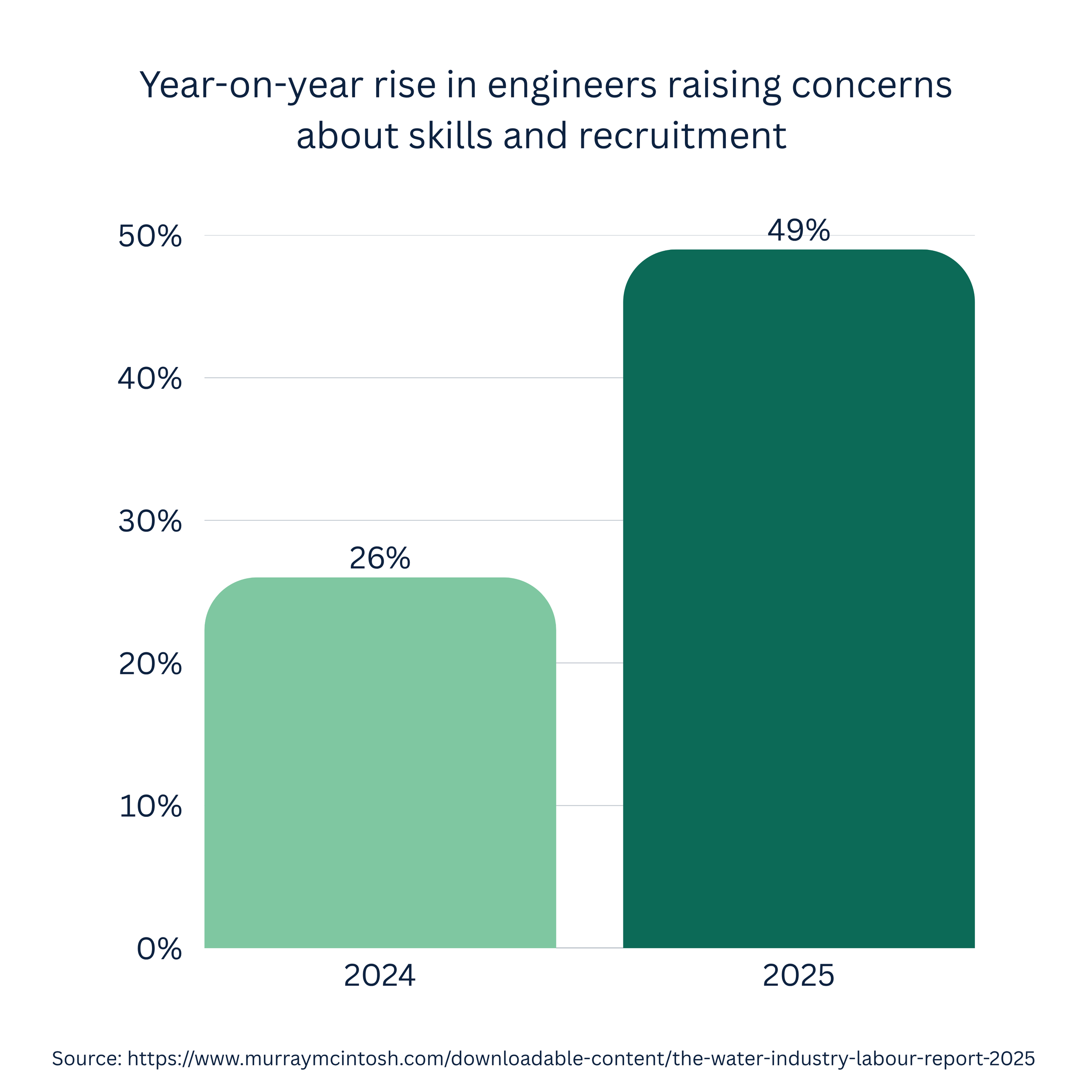
26% → 49% is the year-on-year rise (2024 to 2025) in engineers raising concerns about skills and recruitment [4]
27% of the wider energy and utilities workforce is expected to retire within the next decade [5]
2 in 3 engineers surveyed are considering a move to another sector [4]
Why the Gap Exists
Much of the pressure stems from timing. AMP8 has arrived alongside comparably large investment programmes in clean power and rail, meaning water companies and their delivery partners are competing with other capital-intensive sectors for the same finite pool of project managers, commercial leads and design engineers. At the same time, recent scrutiny of the industry, including high-profile financial difficulties at some water companies, has placed additional pressure on sector reputation at precisely the moment it needs to attract new entrants.
The consequence is a widening gap between approved investment and real-world delivery. Frameworks are in place and budgets are approved, but without sufficient resource to mobilise them, work may not flow at the pace AMP8 requires.
Why This Can’t Wait for AMP9
The implications of an unresolved skills gap extend well beyond individual project delays. Ofwat's Outcome Delivery Incentive (ODI) framework attaches financial penalties to missed performance targets. This means that delivery slippage caused by resourcing shortfalls can translate directly into lower returns for water companies and, in some cases, higher costs passed through to customer bills.
Environmental commitments are similarly exposed. AMP8 targets include the elimination of an estimated 140,000 sewage spills a year and a 25% leakage reduction. Therefore, a shortage of the engineers and project managers needed to design and deliver these schemes puts statutory and environmental outcomes at risk, not just commercial ones.
There is also a compounding effect to consider. Water companies that fall behind on AMP8 delivery will begin AMP9 planning from a weaker starting position, carrying forward both a larger backlog of work and a workforce that has had less time to mature. Given that recruitment, training and accreditation across engineering and commercial disciplines typically take years rather than months, decisions made now about workforce investment will shape delivery capability well beyond 2030. Addressing the skills gap early is therefore not simply a matter of keeping AMP8 on track, but of protecting the sector's ability to deliver future investment cycles at the pace of regulation and customer demand.
The Way Forward: Three Areas for Action
Closing a gap of this scale will not come from a single intervention, but from coordinated action across recruitment, retention, technology and the wider supply chain.
1. Expand the talent pipeline: Water companies should look beyond traditional graduate and apprenticeship routes to adjacent sectors such as rail, highways and defence, where transferable technical and commercial skills already exist. Closer collaboration with colleges and universities is required to align courses with AMP8-relevant disciplines including digitalisation, data analytics and nature-based solutions.
2. Prioritise retention and knowledge transfer: With a significant proportion of the workforce approaching retirement, structured succession planning will determine whether institutional expertise is preserved or lost as experienced staff exit the sector.
3. Use technology to enhance existing capacity: Digital twins, predictive analytics and modular, off-site construction are already reducing the number of skilled hours required on site. Meanwhile, data-as-a-service models allow specialist suppliers to manage data collection and analysis on behalf of stretched internal teams.
AMP8's investment figures are unprecedented, but capital was never the binding constraint – capacity is. Water companies and their supply chains that invest early in pipeline, retention and delivery capability will be better placed to convert approved budgets into completed infrastructure, rather than watching plans stall against a shortage of skilled people.
Deecon works alongside clients across regulated infrastructure sectors to increase delivery capability through a blend of experienced people, better ways of working and technology. In practice, that means strengthening client teams during AMP8 peaks with specialists who bring experience from across infrastructure sectors. We improve governance and controls so approved investment translates into delivery on the ground, and use digital tools and data to help clients get more from the resource they already have.
Written by Elif Beste Gul
Edited by Kate Randall