

£718bn and Counting: Can the UK Actually Build This?
In March 2026, the National Infrastructure and Service Transformation Authority (NISTA) published its first update to the UK Infrastructure Pipeline since its launch in July 2025. It sets out £718 billion of capital investment expected across major UK projects over the next decade. This sits within the government's wider ambition to commit at least £725 billion of public funding to infrastructure over the same period [1].
The scale of ambition is clear, but realising this ambition comes down to two key things:
The effectiveness of the systems for choosing and governing projects
The UK’s delivery capability to build what has been promised
The Shape of the Pipeline
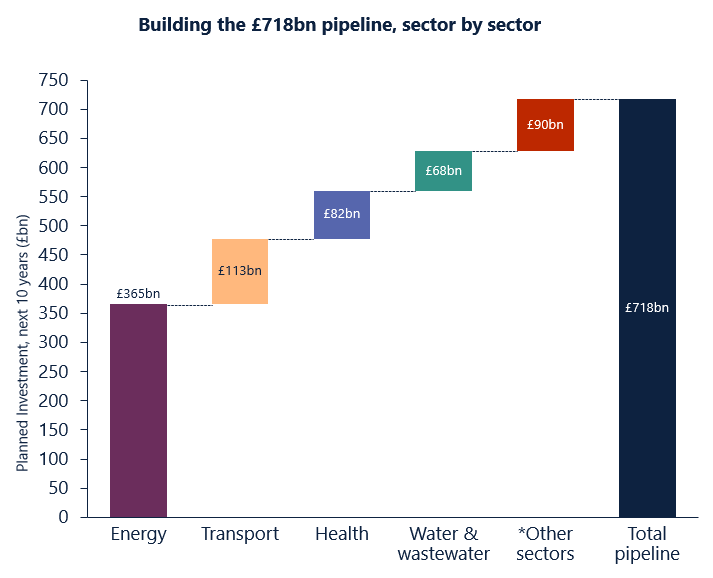
*Includes education, digital, defence housing and flood defence projects not separately itemised.
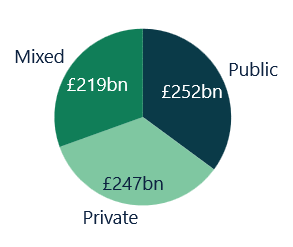
Energy dominates the pipeline, accounting for £365 billion of planned spend, but transport, health, water, and education all feature prominently. Just over a third of the this is publicly funded, with the rest coming from private or blended finance. This underlines that the pipeline's delivery depends on investor confidence as much as government spending.
What Not To Do
The UK 10 Year Infrastructure Strategy is unusually candid about why past projects have gone wrong. It cites HS2 as the clearest example, where the budget has grown from £32.7 billion at approval in 2011 to over £100 billion today. Government reviews found no single cause, but rather a combination of unclear strategic objectives, a design that was allowed to proceed before it was mature, and commercial contracts that created the wrong incentives as costs grew. Whether the pipeline and its governance genuinely close off these types of failures, rather than simply describing them, is the test that matters for every project that follows.
Rail is the clearest test case. A cross-party committee has already warned that the sector needs a consistent long-term vision to give suppliers the confidence to invest [2]. The government's answer is the pipeline itself, a regular delivery plan from Network Rail, and the new Great British Railways, which brings the railway back under public ownership. The government argues that this will mean clearer accountability and better cost control than the current fragmented structure. However, suppliers and investors will base their judgement on delivery, not on the strength of the response.
Rewriting the Rulebook
Alongside the pipeline, HM Treasury has been reworking the Green Book, which is the guidance that underpins how public investment decisions are appraised. Its 2025 review identified some key issues:
Guidance that had become too long and complex
An over-reliance on benefit-cost ratios as a gatekeeping threshold
Limited local capability to build strong business cases.
The revised Green Book, published in early 2026, cuts out a lot of that complexity. It is shorter, it stops treating cost-benefit numbers as a hard pass/fail line, and introduces a new "place-based" approach to business cases. This approach is being trialled now in Liverpool, Birmingham, Port Talbot and Plymouth. Projects will be judged more on their contribution to a location's wider objectives, including the role of transport in unlocking housing and jobs, rather than in isolation.
The Green Book does not work alone. Its sister document, the Magenta Book, governs how projects are evaluated once the money has been spent and it has just had its own biggest rewrite since 2020. Read together, the direction of travel is consistent: whether a project is being chosen or being judged afterwards, the government is pushing both to build evidence around a specific city or region, rather than assessing every project in isolation.
The People Problem
Funding and governance reform address only part of the problem. The biggest risk to the pipeline may not be money but people.
The gap is estimated at around 48 thousand extra workers needed every year just to meet baseline demand, and that shortage isn’t spread evenly [3]. Pressure is most acute in London and the South East, where the highest concentration of major projects competes for the same pool of skilled workers, pushing up costs and pulling talent away from other regions that need it just as much.
That competition is not just regional: it is cross-sector too. Water alone needs 43,700 new recruits by 2030 to deliver its current AMP8 investment programme, competing directly with rail, energy and defence for the same specialists.
The chief executives of major contractors have welcomed the visibility that the pipeline provides, while cautioning that workforce and supply chain capacity must keep pace with the ambition.
Will the Pipeline Succeed?
The honest answer is – it depends. The UK now has a genuinely transparent, long-term view of its infrastructure ambitions, backed by a Treasury review that has confronted some longstanding appraisal weaknesses. Whether that translates into projects delivered on time and on budget will depend on execution. The outcome hinges on business cases that hold up to scrutiny, stable long-term commitments that give the supply chain confidence to invest in people and skills, and governance that catches problems early rather than after billions have been spent.
Deecon's Public Sector team helps to deliver the pipeline: building the evidence that departments need for a strong business case, stress-testing the commercial model, and giving an honest view on what is actually deliverable.
Written by Connor Ovenstone
Edited by Kate Randall