

AI’s Circular Financing: Bubble or Sustainable Boom?
In the race to lead AI, cloud providers and chipmakers are investing heavily in AI startups. Startups that, in turn, spend much of that funding on the very platforms and hardware of their investors. This circular flow of capital has sparked debate: is it fuelling an unsustainable bubble, or is it a strategic mechanism to accelerate infrastructure build-out?
For business leaders, understanding this dynamic is essential to separate hype from reality.
What is Circular Financing in AI?
Circular financing occurs when companies fund their own customers in a closed loop. For example, a cloud or chip supplier invests in an AI startup, and that startup uses the capital to purchase the supplier’s services or hardware. The money flows out as investment and returns as revenue.
While this practice, often called vendor financing, is not new, its scale in AI is unprecedented. Critics liken it to ‘round-tripping’ schemes from the dotcom era, where companies bought each other’s services to inflate revenues. Today’s deals are more transparent and involve tangible assets such as GPUs (specialised processors) and cloud capacity, but they can still distort demand signals if customers rely heavily on investor-backed funding.
Echoes of Past Bubbles - With a Twist
Veterans of the dotcom era see familiar warning signs. Lucent, the electronics company, famously invested in telecom startups that then purchased Lucent’s equipment, until the bubble burst. Short seller Jim Chanos argues that AI risks repeating this pattern, noting that companies are ‘putting money into money-losing firms so those firms can order their chips’ [2].
However, 2025 is not the late 1990s. AI leaders today have real products and revenue streams. Nvidia’s share price and earnings have grown in tandem, and major tech firms trade at far more reasonable multiples than during the dotcom peak. AI demand is also underpinned by tangible infrastructure and widely adopted services such as ChatGPT. Still, cracks exist: some startups with limited substance are attracting outsized funding, and spending often outpaces monetisation, a familiar pattern, updated for the cloud era.
Inside the Circular Deals
Several high-profile examples illustrate the depth of these interconnections:
Microsoft and OpenAI: Microsoft has invested $13.8bn in OpenAI and now holds 27% of its for-profit entity. In return, OpenAI has agreed to purchase up to $250bn of Azure cloud capacity through 2032 - a powerful, long-term feedback loop between investor and customer [3].
Amazon, Anthropic, Microsoft, and Nvidia: Amazon has now committed up to $8bn to Anthropic and remains its primary cloud and training partner via Amazon Web Services (AWS). More recently, Microsoft and Nvidia have agreed to invest up to $15bn ($5bn from Microsoft and $10bn from Nvidia), while Anthropic commits to purchase $30bn of Azure compute over the coming years, running on Nvidia systems. This makes Anthropic a flagship example of AI capital looping back into the same small set of cloud and chip providers [4].
xAI and Nvidia: Elon Musk’s xAI is structuring a $20bn special-purpose vehicle that will buy Nvidia GPUs and lease them back to xAI. Nvidia is reportedly contributing $2bn of equity for the same vehicle, while also supplying the hardware - effectively financing a portion of its own future sales [5].
These deals prompted venture capitalist Azeem Azhar to describe the ecosystem as a ‘financial ouroboros,’ where value continually feeds back into itself.
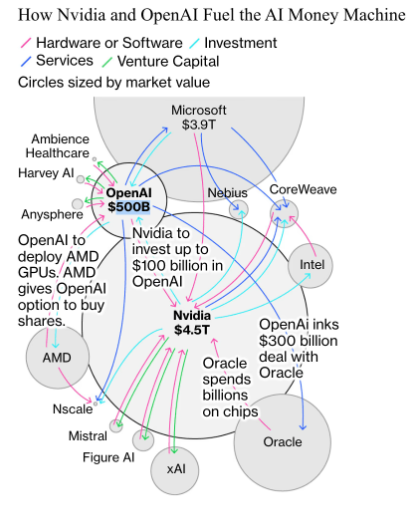
Source: Bloomberg News Reporting
Sustainable Demand or Artificial Hype?
Unlike the dot-com era, today’s exuberance is far from universal; public technology, stocks trade at much lower earnings multiples than in 2000, and private-company valuation-to-revenue ratios have also normalised sharply from their 2021 peaks. Regulators such as the UK’s CMA are now actively probing cloud–AI tie-ups, adding further discipline to the market.
While AI demand isn’t ‘fake’, much of the infrastructure is being built ahead of monetisation, leaving investors exposed to significant utilisation risk. Overall, hype exists, but it is more contained and closely monitored than during the dot-com boom.
A Playbook for Business Leaders
For executives navigating this landscape, the goal is balance, not avoidance. Key principles include:
Rigorous Due Diligence: Validate whether revenues come from genuine customers or investor-backed spending
ROI-Driven Use Cases: Prioritise near-term productivity gains over speculative promises
Watch for Overheating Signals: Extreme valuations, complex financing structures, and overbuilt capacity are red flags
Leverage Vendor Competition: Rivalry among cloud providers can improve pricing and flexibility, but avoid lock-in without clear strategic benefit
Stay Informed and Adaptive: AI is evolving rapidly; combine healthy scepticism with openness to innovation
The Bottom Line
Circular financing is accelerating AI’s infrastructure build-out, but it also introduces risk. Leaders who understand these dynamics, and act with discipline, will be best positioned to utilise the real value of AI amid the hype.
At Deecon, we help organisations make sense of emerging technologies, developing data-driven strategies and planning for adoption in ways that are human-centred, ethical and practical. It is not always about replacing tools, but about making the most of what you already have, identifying where new tools add value, and ensuring those choices are reviewed holistically across the stack.
Words by Andrea Bovina
Edited by Anna Pringle