

Digital Command: Building a PMO That Drives Strategic Defence Outcomes
Traditional PMOs have long struggled in the defence sector, particularly as digital delivery becomes vital to operational readiness. Built to provide control and assurance, many PMOs often succeed at governance while failing to enable timely decision making. This gap becomes even more critical as threats evolve faster than delivery cycles. Success, therefore, is no longer defined solely by adherence to plans, but the ability to identify challenges, decide and act quickly.
Addressing this challenge requires a shift towards digital command: a PMO model that links data, delivery and leadership decisions directly to mission outcomes, readiness and resilience.
For organisations navigating these challenges, partnering with teams that combine operational experience with security-cleared expertise can speed up the shift from process compliance to real-time decision-making – a capability that requires experience across multiple defence programmes.
Digital Command in a Defence Transformation Context
Digital command refers to the ability to translate strategic defence intent into timely, informed delivery decisions. It links digital programmes directly to mission outcomes, readiness and resilience, rather than treating technology as a supporting function.
Where digital command is absent, familiar problems emerge:
Digital initiatives deliver outputs but fail to create practical capabilities
Decision-making is slowed by fragmented data and layered reporting
Systems are deployed too late to respond to changing threat conditions
When digital command is applied effectively, data is not just stored or reported – it is actively used to guide decisions and operations. Leaders can use data in real time to understand risks, dependencies and trade-offs, enabling faster and better informed “go / no-go” decisions across cyber, data and automation initiatives.
Why Traditional PMOs Struggle in Defence
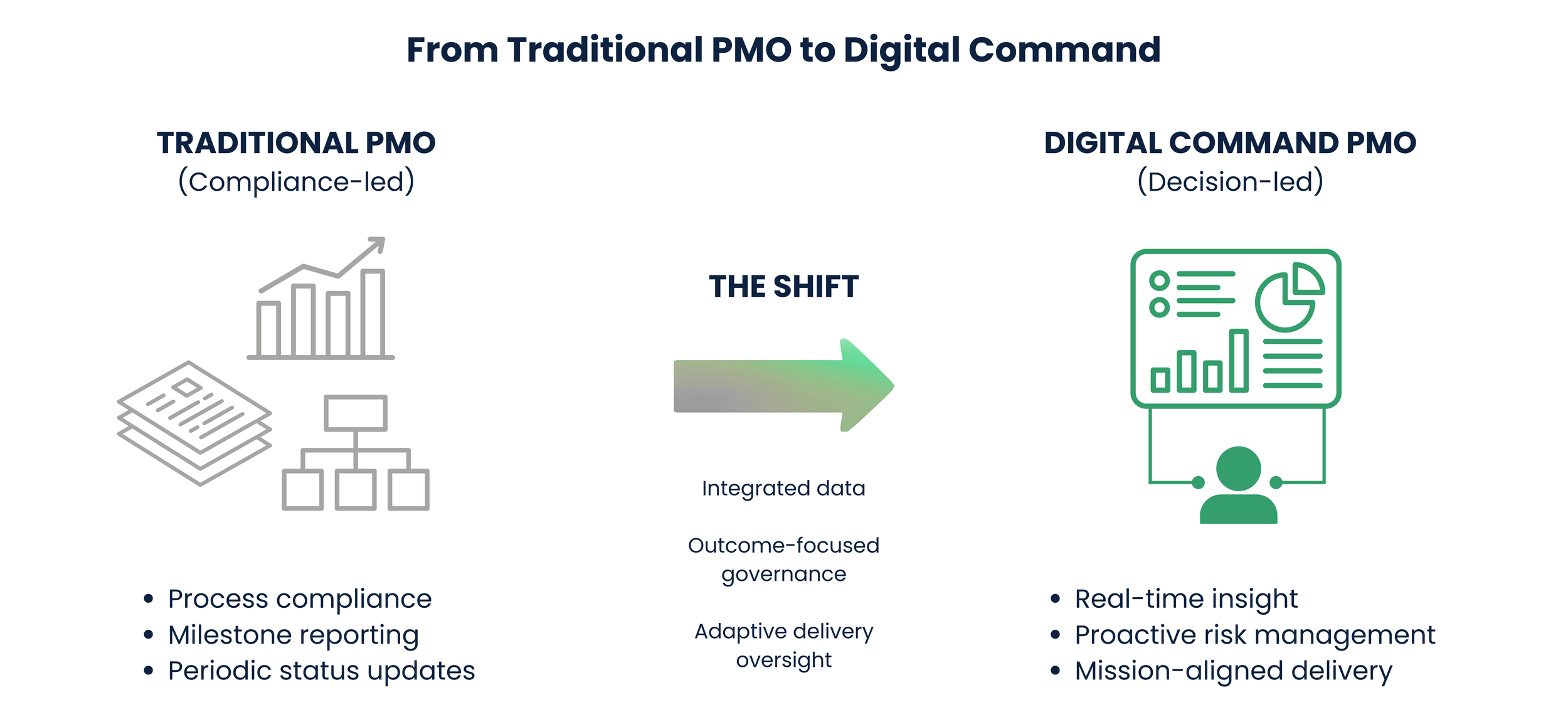
Conventional PMOs are rarely designed to enable digital command. In defence, they often reinforce hierarchy and process at the expense of adaptability.
Common constraints include:
Long delivery horizons, with milestones months apart, reducing urgency
Rigid governance models, poorly suited to digital and cyber delivery
Outdated systems and compliance requirements, limiting change
Reporting-heavy cultures, focused on documentation rather than decisions
The result is a PMO that tracks progress meticulously but struggles to influence outcomes. In a multi-domain, digitally-enabled threat environment, this gap increases over time and traditional PMOs are no longer fit for purpose.
From PMO to Digital Command PMO
A Digital Command PMO (DCPMO) is fundamentally different in purpose and behaviour. Its value lies not in the documents or reports it produces, but in enabling decisions that protect and enhance operational advantage.
Three principles form the basis of the shift:
Outcome-led governance: Success is measured by operational impact, risk reduction and adoption, not just milestone completion
Integrated data and automation: A single source of truth provides real-time visibility across programmes, supported by analytics rather than manual reporting
Adaptive delivery oversight: Delivery approaches are applied pragmatically, flexing between agile and structured methods based on risk and context
Critically, capability and culture are as important as the tools used. Strengthening skills in risk management, data interpretation and collaborative decision-making deliver greater value than new systems alone.
What This Means for Defence Leaders
The question is no longer “do we have a PMO?”, but “does our PMO enable command?”. As digital capability becomes essential for operational readiness, PMOs need to go beyond reporting and control to providing real-time insight, integration across domains and fast decision support. A Digital Command PMO accelerates decision-making by integrating all of these and delivering long-term cost and time savings through better-informed choices.
While investment is required, the benefits are clear: faster delivery, improved resilience, better use of digital capability and measurable efficiency gains.
For defence leaders navigating the current state of rapid digital transformation, the shift from control to command is where real value is unlocked.
By leveraging DV-cleared teams with hands-on delivery expertise, organisations can transform a traditional PMO into a Digital Command PMO. This turns strategy into action, enables integration across domains, and embeds the capability to make fast, informed decisions. Deecon’s experience of creating digital command PMOs demonstrates how this transformation is both achievable and sustainable.
Word by Ehime Ehi-Omoike
Edited by Kate Randall